
Behind the Business of Cyber Crime
Kalamazoo, MI | March 31, 2026
This article at a glance:
- Cybercrime consists of an established ecosystem, not just groups of lone hackers.
- Most cybercrime has become tedious, uneventful work.
- Cybercrime has become so simple, almost anyone can do it.
When you think of the dark web, images of lone hacking geniuses and off-grid hideouts might come to mind.
But the truth about cybercrime? It’s a business.
It’s tempting to look at the online black market as something totally unknown, totally unfamiliar to our daily lives. But in reality, the black market is something very familiar: a market.
So how does this market work? And, why do you need to know about it?
Today, we’re demystifying what the business of cybercrime actually looks like, and what you need to know to stay safe.
The Cybercrime Ecosystem
Most cybercriminals aren’t lone hackers, geniuses, or anonymous elites (though, they’d like you to think that). In reality, they’re more like a criminal version of freelance developers, software engineers, resellers, and your garden variety scammers.
The only thing binding this eclectic bunch together is a pretty familiar concept: they want to maximize profit and minimize risk.
Cybercriminals know that when crime is disorganized, it creates confusion, which hurts profits and increases risk. So, if a cybercriminal wants to keep making money (and not end up in prison), then it’s in their best interest to follow the rules and act like a reliable professional.
To be clear, the dark web isn’t exactly full of rule-followers and gentlemen; they’re cybercriminals, after all, and crime creates criminal personalities. But what’s really important to keep in mind is that the dark web is fueled by self-interest.
Ironically, that means the best way for cybercriminals to protect their interests is to treat their work as a steady job. So just like most legal, 9 – 5 jobs, the world of cybercrime is made up of:
Business startups and established brands
Specialists, contractors, and middle management
Employee churn, business partnerships, and repetitive desk work
Put that way, the world of cybercrime suddenly becomes less mysterious and more… boring.
And here’s the kicker: most hackers would agree.
The Biggest Obstacle Inside Cybercrime: Boredom
A study from the Cambridge Cybercrime Institute found that one of the most common reasons that hackers stop committing cybercrimes is simply due to boredom.
In their study, Cybercrime is (Often) Boring, the researchers write, “Cybercrime... has itself become industrialised, with boring, tedious maintenance and infrastructure jobs outsourced to lowly paid contractors."
In one interview, one malware distributor went on the record to talk about burnout and the effects of boredom, saying:
“...I lost all motivation, and really didn’t care anymore. So I just left and went on with life. It wasn’t challenging enough at all. Creating a stresser is easy. Providing the power to run it is the tricky part. And when you have to put all your effort, all your attention. When you have to sit in front of a computer screen and scan, filter, then filter again over 30 amps per 4 hours it gets annoying.”
The researchers go on to note that many cybercriminals get into crime because it seems like a thrilling way to make money, but quickly leave “…once the low ceiling of social and financial capital which can be gained from this work is reached.”
It’s reassuring to know that most scammers out there aren’t drinking champagne and partying; instead, they’re tired and losing motivation. So, that’s a good thing, right?
Well, not exactly.
Instead, it hints at a much more sinister reality lurking beneath the surface.
Some cybersecurity professionals have started to use boredom as a shield. By protecting sensitive data with long loading times, needlessly repetitive processes, and multiple CAPTCHAs, they can frustrate attackers into simply moving on. At the same time, these time-consuming processes let cybersecurity professionals observe criminal behavior for a longer time.
The Deeper Issue: Cybercrime Has Industrialized
It’s true—gone are the days of cybercrime only being perpetrated by experienced hackers and criminal masterminds. Now, most cybercriminals are bored and burnt out. But the reason for that burnout is the same reason cybercrime is more dangerous than ever: cybercrime has industrialized.
Because cybercrime has become so organized, it’s easier than ever to become a cybercriminal. And one development in particular has changed the game forever: Ransomware-as-a-service.
Ransomware-as-a-service is the criminal version of subscription-as-a-service. You probably already pay for at least one subscription-as-a-service; they’re any service you pay a regular fee to maintain, like:
Netflix
Spotify
Amazon Prime
Costco
Ransomware-as-a-service works the same way. With it, criminals with basically no computer knowledge pay a monthly fee to “subscribe” to a malware tool, which they then use to hack both individuals and organizations.
It all starts when Elite hackers (called “leets”) find a new hack for breaching a cybersecurity system. The Elite then partners with a Distributor to package the hack into an easy-to-use software. Then, they market it to low-skilled cybercriminals called Affiliates, who pay a monthly subscription fee to use it.
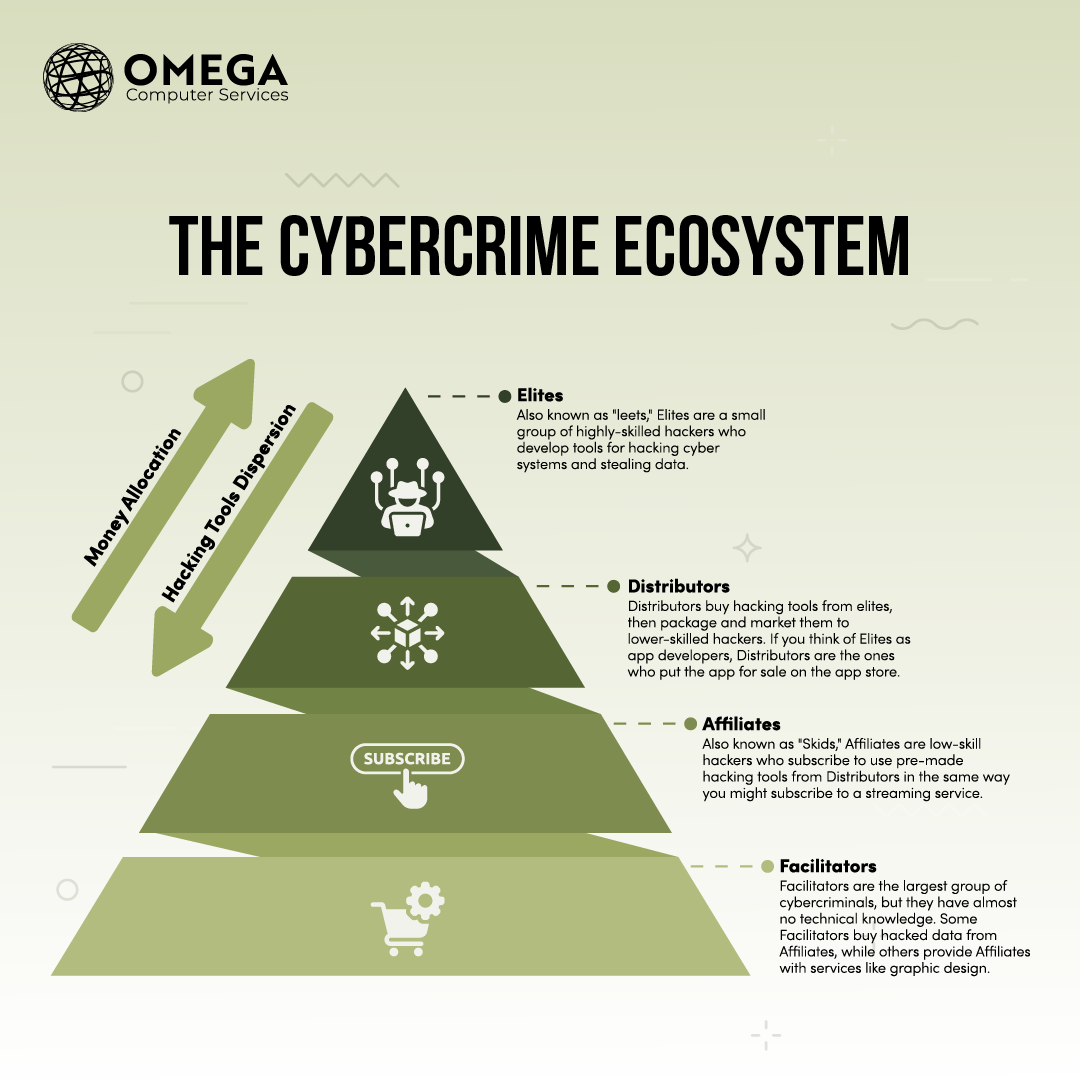
This process is so streamlined, that many ransomware-as-a-service models even offer:
Technical support
Software updates
Profit sharing and affiliate programs
Analytics and campaign tracking
With very little computer knowledge, just about anybody with a Wi-Fi connection can use highly sophisticated hacking tools that, in 2024, cost the average victim 5.2 million dollars. In March 2024, one victim even broke the record for highest ransomware payment of all time, paying 75 million dollars.
So, while it may be true that cybercrime has become “boring” for most cybercriminals, the threat of cybercrime is only rising.
All this begs the question: can you protect yourself from cybercrime?
Protect Your SMB from Cybercrime
Despite the thriving ecosystem of cybercrime in the world, you can take reasonable steps to protect yourself. For small-to-midsize businesses, the best defense will always be working with cybersecurity professionals, such as our team at Omega Computer Services.
As a managed service provider with decades of experience, we protect you from cybercrime through:
Automated data backups
Managed firewall services
Incident response
Threat detection and prevention
And more
For more information on how we can keep you and your business safe from cyberattacks, click here to contact us today!
-
Cybercriminal culture places a high value on hacking ability and “street cred,” yet only a small group of cybercriminals are expert hackers. The vast majority are people looking to commit crimes of opportunity, make money from home, or those who just like the thrill of doing something illegal.
-
A data breach is a security event where unauthorized, malicious agents access and/or steal protected data. Data breaches usually involve highly sensitive information, such as financial data, legal records, intellectual property, or personal information.
-
No, hacktivist groups are instead ideologically or politically motivated. These groups participate in what’s called “hacktivism” or “cyberwarfare,” which is computer-based espionage to push a political agenda. The March 2026 Stryker cyberattacks are one famous example of a politically-motivated cyberattack.
